I have always had a love affair with the Academy Awards but at the end of 2010 I realized how few of the Best Picture winners I’d actually seen. So I made it a goal to see all [then] 83 winners and write my thoughts about them along the way. (I even re-watched the ones I'd already seen so I could write a fresh post.)

That was the initial inspiration behind this blog... I wanted to document my thoughts as well as start a potential conversation or at least ask some thought-provoking questions. Why did it win? Should another movie have won instead? Has it become a beloved classic or do many of you not even recognize the title? For each film, I post the original movie poster, a brief synopsis, the films it was up against, my favorite scene(s), and any lessons I learned.

I have since completed the challenge and have seen all of the Academy's Best Picture winners. (For my collective thoughts at the end of the challenge, including lists of my favorites and least favorites, check out this post.) I keep this blog up-to-date by coming back each year to post my thoughts on the recent winner. I still invite you, my friends and guests, to comment along with me. Do you agree/disagree?

And the Oscar goes to…

Tuesday, January 31, 2023

CODA, 2021


Rated PG-13

Ruby Rossi is a senior in high school and the only hearing member of her all-deaf family. She helps her older brother and parents with the fishing business after school and on weekends, but her passion is singing and she’s good at it. Ironic? She signs up for choir when she sees her crush do so too, but chickens out at auditions.  She comes back for a second chance, and Mr. V, the teacher, accepts her after seeing her potential. He also chooses a duet for her and Miles (the aforementioned crush) to start practicing.

The family relies on Ruby; she’s the only one who can hear the radio on the boat. As an interpreter for the business, she shoulders a great amount of stress in doing so. We can tell there’s a level of protection she’s proud to take on, but also burdened by, so it’s a double edge sword. When she’s overscheduled from pursuing music and practicing for an audition at a prestigious music school, she puts the business in jeopardy and adjustments have to be made. The parents have used her as a crutch; the brother wants to be able to try running the business on their own… so, will they let her be her own person and pursue her dream of music?

I really enjoyed watching this coming-of-age story. I kept saying how “refreshing” it was to watch a film that made me feel a nice range of emotions and also didn’t have me shutting my eyes from gratuitous violence or unnecessary sex scenes, or rolling my eyes from the overuse of curse words or certain agendas being shoved in my face.

The title of this film was simple and perfect. CODA is an acronym for Child of Deaf Adults. Ruby is the CODA as this film gives us a peek into her daily life as the only hearing person in a family of non-hearing individuals. But also, a coda is a musical term. It is an element, long or short, that signifies the end of the song or composition. It brings the piece to a close. As I reflected on this, I couldn’t help but see Ruby’s own eloquent coda in the final scene of the film. She’s being whisked off in her brother’s girlfriend’s car, but has to stop and get out for one last group hug. Then she flings her arms out of the window to sign “I love you”. The end. 


CODA was up against “Dune”, “The Power of the Dog”, “West Side Story”, “Belfast”, “King Richard”, “Drive My Car”, “Don’t Look Up”, “Nightmare Alley”, and “Licorice Pizza”. (I had only seen Spielberg’s remake of “West Side Story”, and while I thought it was excellent, I didn’t think it was going to win). CODA won all three awards it was nominated for (making it the 7th in history for a clean sweep like that) including Best Adapted Screenplay (it’s a remake of a 2014 French film) and Best Supporting Actor (the dad, Frank).

I probably couldn’t get away with talking about this year’s award show without mentioning “The Slap Heard ‘Round the World”. When comedian Chris Rock came out to present an award, prior to listing the nominees, he motioned to Jada Pinket Smith sitting in the front row, and said, “Jada, I love you. G.I. Jane 2, can’t wait to see you.” He was referencing Jada’s closely shaved head (which is a hairstyle she has chosen to proudly flaunt while suffering the effects of Alopecia, a condition that causes hair loss and/or thinning). Jada’s husband, Will Smith, got up, quietly walked up onstage, stood squarely in front of Chris, slapped him across the face, and walked back to his seat. Once there, he yelled, “Keep my wife’s name out of your f--in’ mouth!” Now, since this is my blog, I’m obviously representing my opinions, and I’m not interested in starting debates. I know that we are living in volatile times where tensions are high and points of view can be polarized. But here are my quick two cents: Was the joke insensitive? Sure. Chris is a comedian. It’s common knowledge that comedians hit below the belt. Most of a stand-up’s routine is either spent shelling out uncomfortable truths, backward revelations, or jabs that nobody else is brave enough to say. If you can’t stand the heat, then get out of the kitchen. You’d think Hollywood actors would’ve grown some tougher skin than this by now. Doesn’t anyone remember Ricky Gervais? What you DON’T do if you don’t like a performance by a comedian, or a musician, or an actor, or ANYONE, is walk up on THEIR performance space and assault them. I was in musical theatre for years. It frightens me to think that if I offended someone by singing off key, I might get a bicycle kick to the neck these days. Chris handled it like a pro onstage. Will should’ve been escorted out that evening; instead, he went on to receive the award for Best Actor that evening (and later, the Academy announced he’s not to return to the Award Show for 10 years, thankyouverymuch). I think Will is a brilliant actor, so I truly hope he's taken a step back and done some personal work and accountability. 


MEMORABLE SCENES:

Ruby’s family attends her class’s recital (along with her brother’s girlfriend who helps interpret). It’s a touching scene because you can sense Ruby’s nervousness and excitement to perform and the pride she takes in her family being there even though she knows they won’t be able to truly enjoy it. It’s also a little heartbreaking to watch her parents look around the room at the faces of the other parents. They’re wondering if their daughter is any good. They see the entire audience smile, nod along, and even tear up at such a moving performance. This was the one time in the movie where the director decided to take our hearing away too which I thought was a very interesting and well-timed choice. We sat in silence for part of the duet and in solidarity with Frank and Jackie as they just watched their beautiful daughter do something she professed she loved doing. At the end, they waved their hands in utter pride. 


When they returned from the recital, Ruby’s dad asked her what the song was about and for her to sing for him again. He placed his hands on her throat and neck so he could feel the vibrations and asked her to sing louder. It was a touching, bonding moment. 


LESSONS LEARNED:

1. Keep those lines of communication open in the teen years. I admired Ruby’s relationship with her mom. They joke around but they also have a sweet heart-to-heart when Jackie is vulnerable and admits something that’s hard to hear. You can tell that has only come from years of practice and little “check-ins”.

2. Sometimes, teachers are the saving grace in a kid’s life. If you’re a teacher and you’re reading this, never underestimate the power you have in motivating a student. Your encouragement (even if it comes from a place of “tough love”) may be just what this one kid needs to hear to change his/her mind, or make him/her feel loved, appreciated, valued, or heard. 


Thursday, October 21, 2021

Nomadland, 2020


Rated R

This year's Academy Awards show was just about the worst one I've had to sit through (and yes, I sat through the Hathaway & Franco debacle and the "Is it Moonlight or LaLaLand?" disaster). The show was broadcast two months later than usual to allow for a longer eligibility period for films. I was ready to extend all sorts of grace given this was the first year they've had to navigate an award show during a pandemic, but it had high school dance written all over it. Critics wrote afterward that it was the lowest-rated and viewed award show in history. Many viewers even turned it off mid-air due to the politically- and racially-charged comments of the celebrities. But I'm not here to discuss the caliber of the show itself, so I'll jump ahead to what should have been the most exciting, but was rather anticlimactic (par-for-the-course) - the Best Picture winner....

"Nomadland" follows Fern, played by Francis McDormand, as she travels across the American west in her van after losing her job at a factory that has shut down due to the recession in 2008. Her husband recently passed away and she's off to find temp work and live the nomadic life since the entire town has dissolved as well and now she is "house-less". She ends up selling rocks in Arizona, working the Badlands National Park in South Dakota, and packing boxes for Amazon around the holidays. We're also given a peek inside "van life" complete with the harsh realities of surviving frigid winters and my least favorite: bathroom situations. She meets new friends (some she returns to seasonally) in different nomadic communities, but you can tell she keeps her distance somewhat and won't invest too deeply. 

There is a difference between being secluded and feeling lonely. A lot of us probably dream of peaceful retreats - time away from the hustle and bustle of the city, the noise, the responsibility, (the kids?) - where we are sheltered with our own thoughts and given time to process and reflect. Granted, seclusion can lead to loneliness, and I think Fern ended up going through periods of this during her journey. She was an empath who related surprisingly well with others. We'd see her listen, laugh, and give occasional pieces of advice. But she'd also close up like a clam. 

Also, there is a difference between wanderlust and a purely nomadic lifestyle due to circumstantial loss or grief. People have looked at this film and thought, "wouldn't it be great just to pick up and go?" First, they've missed the point of the impetus of this community's "movement". We hear from [real-life] nomads in the film who travel for reasons of financial ruin, addiction, and family dysfunction, among others. Some stop and "settle back down" like one character named Dave, but most are on the move, never putting down roots again and you can sense this has altered their perspective - definitely making them more jaded and/or guarded in a way. 

I didn't not like this movie, but it wasn't one I connected with on a personal or spiritual level. I respected the somber tone and the persevering gumption Fern had to keep surviving. But overall, I felt the movie dragged on; I wanted it to pull over and let me out. 

The film's cinematography had its moments though for sure - there were shots that were quite stunning, proving that the breathtaking landscape of the American west is one that should be noted and visited. 

"Nomadland" was up against "The Father", "Mank", "Minari", "Judas and the Black Messiah", "Promising Young Woman", "Sound of Metal", and "The Trial of the Chicago 7". I had not seen any of these films and honestly, I still don't care to. So I'm not offering a very good defense of "Nomadland"'s win- but this is my blog and opinion anyway. All eight films grossed a worldwide total of barely $35 million at the time of the show, which is an unimpressive amount for even one film usually. "Nomadland" had six nominations and walked away with three wins including Best Director and Best Actress. (While she was entertaining, I much preferred McDormand in "Three Billboards Outside Ebbing, Missouri" in 2017). 

MEMORABLE SCENES:

Whenever Fern would have little heart-to-hearts with the other older female nomads, I tended to smile. They swapped truth bombs and nuggets of wisdom. These are two real-life nomads, Swankie (L) and Linda May (R).

LESSONS LEARNED:

1. For many hard working Americans, "the American Dream" is a cruel joke. 

2. Community is where it's at. Even though Fern chose the life of a nomad, she would meet up with these traveling communities, because it is with sharing and a sense of community that one finds companionship and purpose. She smiled more; she served and helped others, and carried on conversations that made her think more about herself and her predicaments. 

Thursday, June 24, 2021

Parasite, 2019


Rated R

I actually watched this Best Picture winner not long after it won the award back in February of 2020, but the next month the world seemed to shut down due to the COVID-19 pandemic. We were all strongly encouraged to shelter-in-place; "distance learning" commenced, and my hubby and I decided to homeschool our children the next year. It literally felt like we were surrounded by the living representation of the title of this movie - our own parasitic creations. Our beloved offspring seemed to suck every moment of "spare" time and patience right out of me, not to mention every bit of food out of our pantry. 

That said, I'm a year behind in posting this review, but better late than never, right? I'm holding myself accountable to comment on every Best Picture winner, and this one is special. "Parasite" is the first non-English language film to win Best Picture. (It was the first nomination for a South Korean film in the Academy's history). The film is a combo satire/suspense/psychological thriller. I mentioned to a good friend of mine that Hubby and I were going to watch it one night and she said, "Oh, I loved that movie!" I asked her if there was a lot of blood or if it was scary, because I'm not really a fan of either. She said, "Uh.. no. Not that I can remember." Dear reader, let me warn you now, if you haven't watched it, that my friend had amnesia. 😑 We only got through half of the film the first night and we thought it was extremely clever, even laugh-out-loud funny at times, and I questioned its R rating. Right at the halfway point, where we stopped it, I thought, this could take a very different turn. And it did. 

The Kims, a working-class family who live beneath a shop, take odd jobs and end up weaseling their way into working for the affluent Park family as they each pose as different skilled workers that the Park family suddenly (and conveniently) find themselves needing to hire. The thrilling twist comes when the Kim family discovers what is already residing in the Park household when they find themselves housesitting one weekend. Without giving away the psychological pieces of the story, prepare yourself for bloodshed at the end if you're opposed to that. (I turned my head at a few very gruesome moments). 

Overall, I am so glad I saw this film (after I yelled at my friend) because it was through this sardonic experiment of human behavior that my mind continued reeling for days afterward. I kept thinking about class discrimination, ignorance, the lengths one goes to when driven by greed, the sacrifices one makes for one's family, and the holes one can dig themselves into if not careful. And even now, almost a year and a half later, I'm realizing that writer/director Bong Joon-ho was likely calling us all to action or at least responsibility within our stations/classes or we will continue to feed off each other in a continual cycle of stubbornness and/or greed. The goal is to find our shared humanity. Although I didn't see all the nominated films this year, I believe this one deserved Best Picture and I am so pleased that an international film won the distinguished award. 

"Parasite" was up against "Ford v Ferrari", "The Irishman", "Jojo Rabbit", "Joker", "Little Women", "Marriage Story", "1917", and "Once Upon a Time... in Hollywood". This was the first year that four films had double-digit nominations (10 or 11); "Parasite" only had six. It took away four of those wins with Best Picture, Best Director, Best Original Screenplay, and Best International Feature Film. Interestingly, many of the nominated films had dark or gloomy plotlines. "Little Women", however, was a remake of a beloved classic. I thought it was truly lovely. I enjoyed the interactions between the four sisters (although I thought the woman who played Amy actually looked older than Beth). However, I'm still partial to the 1995 version with Susan Sarandon, Claire Danes, and Winona Ryder. I was also incredibly impressed with Adam Driver's performance in "Marriage Story". 

FAVORITE SCENE(S):
I'm not sure that I had a specific favorite scene but I especially enjoyed the second quarter of the film, which detailed how each member of the Kim family came to be employed by the Park family. I thought it was creatively done.


MEMORABLE QUOTE:
"You know what kind of plan never fails? No plan. No plan at all. You know why? Because life cannot be planned." Mr. Kim says this to his son after a flash flood destroys their home under the shop and they are forced to sleep in a gym. While I understand the sentiment - life can throw you curveballs that you can't control or are unprepared for - this is not an excuse to not have a rough plan or dream for your life. Successful people become that by dreaming and putting a plan into action. Will everything always go according to plan? No, but having options and avenues to pivot to are valuable when there is a diversion.

LESSONS LEARNED:
Envy can make us blind. Thinking that finally having what someone else has will make us happy is a fantasy. It's a temporary fix to a deeper problem. Focusing on what's missing in our lives only makes us blind to what we have. There's a reason it's one of the "seven deadly sins" - it can be destructive and all-consuming. 

Wealth doesn't make one immune to misery. 

Do a background check or at least ask for more than one reference when hiring people to work in your home. Yikes. 

Don't rely on friends to remember everything about a movie and give good recommendations. 😉


Wednesday, July 10, 2019

Green Book, 2018


Rated PG-13


Green Book was the award-winning biopic that snagged the top honor this year, and I finally had the chance to sit down and watch it last month. I can always appreciate a film that teaches me something about history, and in this film, I learned that the title refers to The Negro Motorist Green Book that circulated for those traveling in the south from 1936-1966. This thick pamphlet, a “safe traveling companion” of sorts, indicated where people of color could dine and stay the night, navigating its owner through the volatile areas of the segregated south. 


The movie is inspired by the true story of Dr. Don Shirley, a classically trained and talented pianist who, in 1962, has been scheduled to tour the southern states for several months giving highly-anticipated performances for wealthy and well-known people along the way. Here’s what makes for an interesting story though… Dr. Shirley is an African-American man and he doesn’t like to drive. He not only needs to hire a driver but needs to hire someone who can “take care of business” if something comes up. Since he’s a learned, wealthy black man about to travel deep into Jim Crow territory, unpredictable situations might arise. Enter Tony ‘Lip’ Vallelonga, played brilliantly by Viggo Mortensen, who knows how to throw a good punch, doesn’t allow backtalk, and will eat 26 hot dogs just to win a $50 bet. At first Tony doesn’t think he’s the right man for the job, but because he needs the money to support his family, he signs on to be at Dr. Shirley’s beck and call for several months, as long as he’s back by Christmas. Tony’s given the Green Book as his guide and the road trip commences. And the audience is treated to a reverse “Driving Miss Daisy” in a way – plenty of sarcasm, cantankerous comments, and odd looks in the rearview mirror will have you laughing out loud.

This odd couple couldn’t be more different… Dr. Shirley lives like a king above Carnegie Hall and comes across as elitist and snobbish. Tony is a practical working-class Italian-American from the Bronx who says what he means and is lacking in etiquette. BUT, given those differences, these men learn to not only work well together, but actually get along (eventually). Along the way, we get to see a more compassionate side of Tony and a vulnerable side of Dr. Shirley. It’s understandable how this real-life duo developed a life-long friendship.

It wasn’t all funny and feel-good though- there are scenes that had me shaking my head in shame at our country’s ignorance and inexcusable hatred. But at times, I was proud of both men and how they handled certain situations, albeit differently.

In the end, it was clear that these men were changed for the better because of the time they spent together. Lessons were learned, opinions were altered, and lives were thus impacted forever.

“Green Book” was up against “BlacKkKlansman”, “Black Panther”, “Roma”, “A Star is Born”, “Vice”, “The Favourite”, and “Bohemian Rhapsody”. (Is it fair that “Roma” is in the Best Picture category and the Best Foreign Language Film category…?) I would’ve liked to see “Mary Poppins Returns” get a nom, simply because I am a Disneyphile and I thought it was a brilliant sequel. Unfortunately, I haven’t seen any of the other nominees so I can’t rightly compare, but I will say that almost all of them were the forerunner at some point. After “A Star is Born” came out, that’s all anyone talked about and it was a shoo-in to win. Then “Bohemian Rhapsody” won the Golden Globe for Best Motion Picture, Drama [and “Green Book” won for Best Motion Picture, Musical or Comedy…. does that confuse anyone else?!?!], so people thought “Bohemian Rhapsody would snag the Oscar. But then, like days before the Awards ceremony, all people could talk about was “Roma”. So really, I had no idea who would win and figured they were all probably pretty good.

 “Green Book” had five nominations and three wins including Best Original Screenplay and Best Supporting Actor which went to Mahershala Ali (for Dr. Shirley). This was almost a back-to-back win in the same category for him since he won for “Moonlight” in 2016. Interestingly, this was only the fifth time in Oscar history that the winning film’s director wasn’t even nominated.


FAVORITE SCENES:

It is abundantly clear that Tony is not one with romantic words, and Dr. Shirley is made painfully aware of this during a pit stop when watching Tony attempt to write a letter home to his wife. Dr. Shirley ends up giving him some writing advice (that have the lady relatives back home swooning) but keeps it real enough for Tony. It’s a humorous scene as Dr. Shirley even works in a spelling lesson. 


Tony gets Dr. Shirley to let loose in a club unlike any he’s played in before and it was a joy to see him smile so naturally like that.


LESSONS LEARNED:

1.       Another favorite scene of mine was when the two men were arguing about how the other didn’t know who the other really was (their background). Tony accused Dr. Shirley of complaining while living in a castle and Dr. Shirley shot back with,

Yes, I live in a castle, Tony! Alone. And rich white people pay me to play piano for them because it makes them feel cultured. But as soon as I step off that stage, I go right back to being just another nigger to them. Because that is their true culture. And I suffer that slight alone, because I'm not accepted by my own people 'cause I'm not like them, either. So, if I'm not black enough and if I'm not white enough and if I'm not man enough, then tell me, Tony, what am I?

I thought this was a profound statement. Whether we mean to or not, we expect people to fit into a nice little box. It’s easier for us if people behave the way we expect them to behave, but this is too simplistic. We are all complicated and unique. Imperfect people make gross exaggerations on racial, social, and economic profiles too. Obviously, it’s wrong and massively unfair for all involved. It’s sickening that Dr. Shirley didn’t feel at home with “his people” because of his education and talent and also didn’t feel accepted elsewhere because of his skin color.

I wish I had a profound answer or solution to this. Instead, I just keep ruminating on it and wishing there was a way we could accept each culture for what it offers and each person for the child of God that s/he is. If God sees us all as the human race, then why can’t we?


2.       A long road trip is a great way to get to know somebody (or get on somebody’s nerves). 


Tuesday, August 21, 2018

The Shape of Water, 2017

Rated R

I started to watch this year’s Best Picture winner on board my flight to Europe this summer, thinking it was the perfect time to relax and jot down some of my thoughts. I guess I totally forgot that I was traveling with my four children and that I wouldn’t have one minute of peace or silence since my two year old would be in my face the whole time. I also noticed twenty minutes in that something was blurred out and I then remembered it saying that the film had been “modified and edited for content” so I turned it off. If I couldn’t watch the “real” version, I couldn't give an honest opinion.
I was able to sit down a couple of months later, and I have to say, I did not fall in love with this movie, nor with the aquatic creature that our main character does. The Director/Writer Guillermo Del Toro says this is a “fairytale for troubled times”. Overall, I found it rather ridiculous and sometimes laughably so. But, for tradition’s sake, I’ll go through with the plot line and my thoughts on it all…

The narrator introduces the main character, Elisa, and describes her as a princess, letting us know off the bat how we should feel for her and this fairytale film. Elisa cannot speak, but can hear and use sign language, so she seems to get along just fine. She even cares for her next door neighbor who appears to be one of her two friends. The other is Zelda, and the two of them work as night-time cleaning ladies at an aeronautical research institute. The setting is early 1960’s Baltimore, in the middle of the Russian space/science race. A “highly sensitive specimen” gets delivered to the institute (Lord knows why exactly), and Elisa befriends it, bringing it her favorite food, hard-boiled eggs, and playing music for it on a record player. Though wild, the amphibious creature (who looks a whole lot like the Creature from the Black Lagoon) learns she is a gentle soul, unlike the fairytale villain, Strickland, who uses an electric cattle prod when he doesn’t behave as expected.

Elisa decides, with the help of her two friends, to bust Fish-Man out of his watery cage and release him when the canals are at their fullest, on a specific date in October. He spends a good deal of time in her bathtub waiting for his release date. (Meanwhile, drama goes down between a Russian spy/scientist and Strickland who’s in deep water, no pun intended, for letting the specimen escape.) While it is clear Elisa has sincere feelings for Fish-Man and his well-being, I think it is too far-fetched of an idea to believe she actually falls in love with him. But she does; she feels connected to him like no other, and they share a love scene in her flooded bathroom. Then we have to learn about a few of the details as she signs them to Zelda. TMI, thanks.

ENDING SPOILER: In typical fairytale fashion, the monstrous villain is destroyed and the happy couple is reunited in love and live happily ever after… in water.

Del Toro is quite the visionary though, I’ll give him that. He wanted people to see this film as “realistic historical fiction” and NOT as fantasy, or sci-fi, bless his heart. His film definitely had a well thought out look. Almost everything in the film appears to be wet or relates to water… whether it’s actually raining, or there’s a massive leak, or the main character is mopping the floor of the institute. Also, the color palette for the whole movie seems to have settled on blues and greens, aquatic in tone. Add to that the music and camera work, both of which sound/seem fluid in nature, and it’s a wonder I didn’t get seasick. The camera’s focus almost floats from scene to scene rather effortlessly, and the accompanying music sweeps you along melodically, not punctuated at all.

There were three or four scenes that contained nudity, most of which I thought were unnecessary. There was also offensive language- they seemed to want to cover all bases so there were inappropriate comments made to or about women, blacks, homosexuals, and the disabled.

I went ahead and watched the special features on my rented DVD which had a few interviews of the cast and crew. Ironically, they each exuded more heart-felt emotion describing the film than when they actually made it. Regardless, I still didn’t believe them when they said this is “the ultimate love story”. And all I felt was bad for Sally Hawkins (Elisa) who said that for us to believe they were falling in love, it had “to be real and right”…. agreed; and it was not.  And then she lost me for good when she tried to convince us that “love can literally break down walls”. There aren’t enough eye-rolling emojis in the world to go after that.

This year’s broadcast had the lowest viewing audience in history which could be due to a number of reasons: the disinterest from the lack of more popular blockbusters on the ballot, the ever-increasing run-time of the show year after year, and/or even the politicization of Hollywood and cultural movements like #MeToo and Time’s Up. “The Shape of Water” had a whopping thirteen nominations and won four awards, including Best Director, Best Original Score, and Best Production Design (those three didn’t surprise me based on what I mentioned above). This drama/fantasy/romance film was up against “Darkest Hour”, “Call Me by Your Name”, “Ladybird”, “Dunkirk”, “The Post”, “Get Out”, “Phantom Thread”, and the oddest titled one, “Three Billboards Outside Ebbing, Missouri”. Most critics predicted that last one to win BP. 


FAVORITE SCENES:

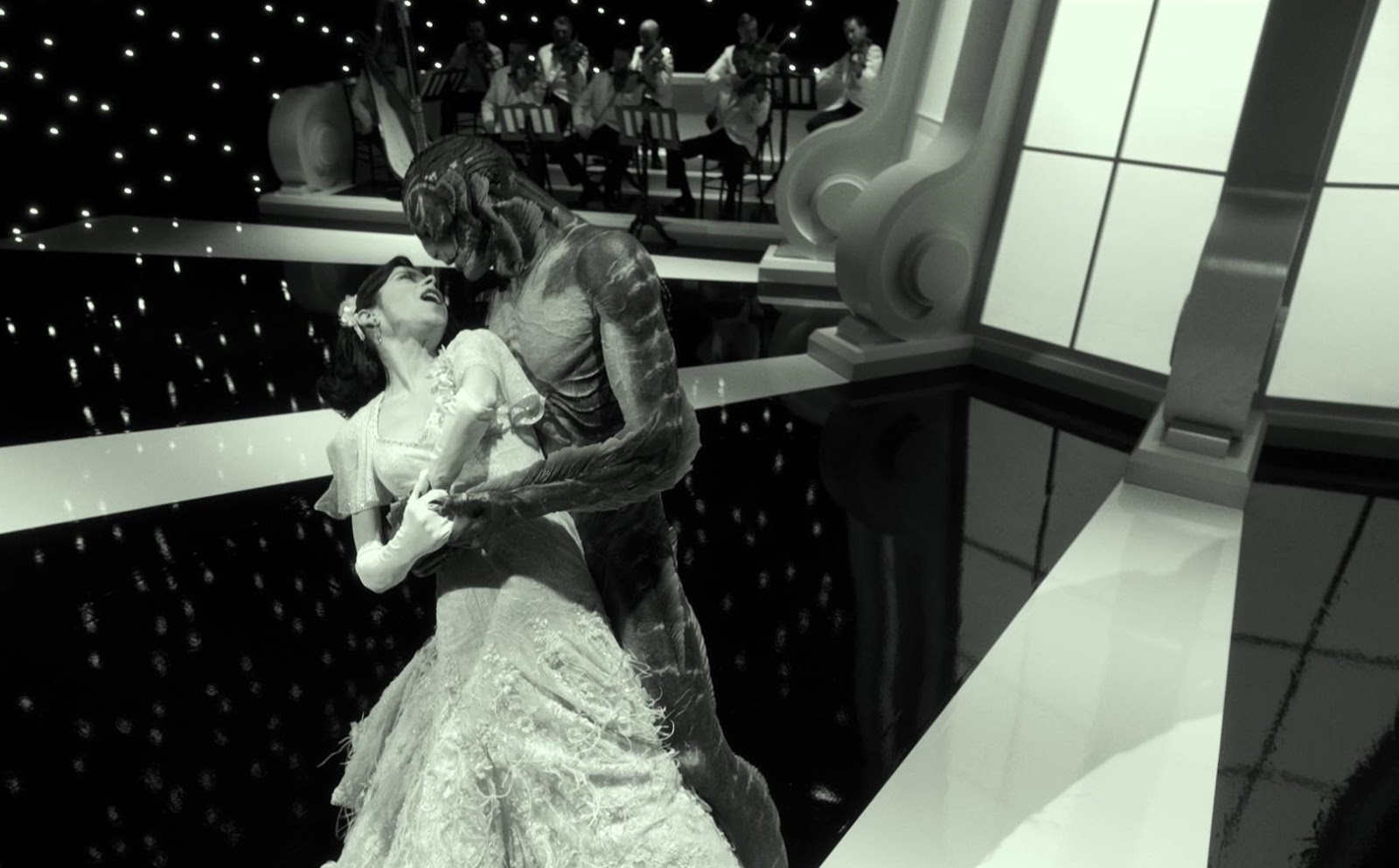
“Favorite” meaning this scene is memorable because it made me laugh out loud and roll my eyes at the same time. There is a black and white daydream sequence where Elisa starts professing her love for Fish-Man through song and dance. It looks like it came straight from the ending of the Best Picture winner of 2011, “The Artist”. Compare….


I have to admit that the ending suited this fairytale well. No matter how harebrained the storyline is, I root for love.


LESSONS LEARNED:


Empathy is an honorable character trait and/or complicated skill to possess and/or cultivate. No matter how it is properly defined, a person who is empathetic is automatically more trusting and relatable. Empathy allows for more intimacy, tearing down barriers like facades. 


Love can grow in the oddest of places. And who am I to question its validity? Just a critic. 

Friday, April 28, 2017

Moonlight, 2016

Rated R

 Following last year’s winner, “Spotlight”, we have “Moonlight”. This came as quite a shock to me… as well as EVERYONE that night in the Dolby theatre and watching at home. In case you missed it, the already 6-time winner, “La La Land” was pretty much a shoo-in for the top award. That’s all anyone was talking about. “La La Land” was special; it was different; it was a fun musical with an interesting love story. Critics and fans all over called it. Nobody was really talking about “Moonlight”. Then Warren Beatty and Faye Dunaway take the mic to announce the Best Picture winner. Warren, for a brief second, looks a little confused, but keeps smiling and shows the card to Faye, who happily says, “La La Land”!!! The appropriate people take the stage and start making speeches, except Warren comes back out with Jimmy Kimmel, the host, to explain that this was NOT a joke, but that the wrong card was handed out (it was a duplicate from when Emma Stone won Best Actress for “LLL”), and “Moonlight” was indeed the real winner. Cue gasps from the audience and the awkward switching of important people on stage.

“Moonlight” is a coming-of-age drama told in three acts. Chiron, who goes by the nickname Little, is a young black boy living in the projects of Miami (in the late ‘80s/early ‘90s?). We see he is a shy, quiet boy who lives with his crack-addicted Mama, and occasionally gets picked on by his peers. He finds a friend in an adult black man named Juan who kind of takes him under his wing, providing him with home-cooked meals and opportunities for safe and open conversations. We get the first glimpse of Chiron’s struggle with identity: he asks Juan what faggot means and if he is one. At one point, the little nine-year-old comes home to an empty house and pours himself a bath using hot water from the stove; I just wanted to pull him out and hug him tight. Unfortunately, Juan is a drug dealer who ironically is providing Chiron’s mom with her fixes. When Chiron discovers this, you can tell it will affect their relationship. We don’t know how it does though, because act two starts and we learn that Juan has passed away years ago.

In act two, Chiron is a teenager who still seems shy and naïve. He has one friend, Kevin, who he has one (non-explicit) sexual/sensual encounter with while sharing an intimate conversation on the beach late at night. It’s clear Chiron is inexperienced and perhaps confused, like many adolescents. Kevin ends up betraying him though when, egged on by the school bully, he beats up Chiron. This clearly was a turning point in Chiron’s life that hardened his heart and closed him off from having any other future intimate relationships of any kind.  


In act three, we find Chiron a decade older, and hardened into manhood. Apparently, upon release from juvie, he started “trapping” (which I had to look up- it means setting up drug deals on corners) and made quite a name for himself. I held out hope that he had listened to Juan’s advice years before, “At some point, you gotta decide for yourself who you’re going to be. Can’t let nobody make that decision for you.” I mean, I guess he did; I had just hoped it would be for the positive. The film ends shortly after Kevin reaches out to him by phone one random day and Chiron decides to drive back to Miami from Atlanta to visit him. The encounter is a little awkward as both men avoid talking too much about the past and their unstable futures. We don’t know what the future holds for Chiron… will he ever turn his life around and open his heart?


Overall, I thought the movie was alright. I thought the acting was great. I can appreciate the story itself and the gravitas it has in today’s society. But I did think the film moved on a little too slow.
 
I LOVE the movie poster. It’s very simplistic in its image and coloring, but intriguing in its effect; the three actors’ faces are sliced into one face- the three different, but related, colors also symbolizing the three parts of Chiron’s life journey in the film: childhood, adolescence, and adulthood. The color palette was fitting; in the first third of the film, Juan explains to “Little” why his nickname was “Blue” (an old Cuban lady said that when little black boys run under the moonlight, they soak up all the light and look blue).  I couldn’t help but think of the phrase, “black and blue” throughout the film. Chiron’s body took a beating, but more importantly, his heart did too.
 
This film was up against “Arrival”, “Fences”, “Hacksaw Ridge”, “Hell or High Water”, “Hidden Figures”, “Lion”, “Manchester by the Sea”, and the one everyone thought would snag the award, “La La Land”. Of these nominees, I have seen “Arrival” and “La La Land”, but I’m very interested in seeing a few of the others. I thought “Arrival” was VERY interesting- a subject I haven’t seen done much in movies (and I’m not talking about alien invasion). “La La Land” was cute. The ending kind of threw me and I’m not a fan of Emma Stone, so that may be why I’m not singing its praises (as a BIG fan of musicals). “Moonlight” also won awards for Best Supporting Actor and Best Adapted Screenplay. It was the lowest-grossing film among its nominees. From a historical standpoint regarding the Awards, this is the first film to win Best Picture that not only had a homosexual main character but also had a completely non-white cast.
 
FAVORITE SCENE:
 
Juan, albeit not perfect, was the father-figure that young Chiron was missing in his life. “Little” was desperate for the positive attention and their relationship was special, even if short-lived. It was reassuring to know that Chiron experienced a parental love like that in small doses. Who knows where he’d be if Juan (and his sweet girlfriend) never stepped into his life? One scene that made me smile was when Juan took Chiron to the beach to teach him to swim. The dialogue is barely audible over the music, but that’s intentional; it’s not the point. You can see the trust Chiron has in Juan as he learns to relax in the water and float. The symbolism here was not lost on me either… Juan’s hands, lightly supporting this emotionally fragile boy’s body, saying in so few words, “I’ve got you”.  
 
LESSONS LEARNED:

 
A child’s upbringing shapes who s/he becomes as an adult. The past leaves physical, emotional, and mental scars that affect the person’s life forever. This may seem obvious and almost cliché; but it is painfully apparent how precious the time is when a child is young. As adults, we have the responsibility to mold and shape our youth, equipping them with self-confidence, awareness, compassion, hope, and a drive to do good.

 
Children want (and need) to be heard. As parents/teachers/friends, we need to lend an ear as they learn to work through difficulties. We need to be available for them.


Saturday, June 11, 2016

Spotlight, 2015

Rated R

I admit I was hesitant to watch this film. I am a born-and-raised Catholic and am proud of my faith. I am certainly not proud of the atrocities that have happened under the shroud of this religion. I had a fear this film would Hollywood-ize these tragic events and end up making blanket statements that ‘Catholicism is corrupt’ or ‘most priests are pedophiles.’ “Spotlight” did not do that, in its defense, but I can’t help but wonder how many more people were turned off to religion because of it, and that saddens me.

The journalistic team behind Spotlight, a side circulation of the Boston Globe, is responsible for focusing on and bringing to light major stories, and in 2001, they dig up a doozie. What is first an investigation into a few child abuse cases within the local Catholic Diocese, snowballs into a major scandal that involves a shocking 80+ cases and reveals that these priests were not punished, but rather just relocated to different churches or dioceses. It’s a sickening revelation. Boston has a very large population of Catholics, many of whom we realize have been affected in some way by abuse but have been too afraid to come forward. We learn the Church capitalized on this fear, paid out-of-court settlements when needed, and simply rerouted the offenders rather than jailing them and seeking therapy. The movie follows the team as they discover more and more cases and speak to more and more victims. The end of the film lists the names of the dioceses across the US that were/are under question (although the list is not complete) after this sparked a nation-wide investigation.

Another disconcerting piece of this scandal though is that the Boston Globe had been sitting on information given to them by previous victims for many years before this was sufficiently given the attention it deserved. Boxes of evidence were shelved in the basement because somebody dismissed it as speculation or insubstantial. Later victims could have been saved if this had been brought to light sooner. Yet another upsetting part of all this, is the small group of lawyers who represented the Church, settling for pittances in order to basically shut the victims and their families up. So. Many. Disastrous. Mistakes.

Overall, I think the film was well done but don’t think it deserved this top award for the year. I can’t help but wonder if the Academy felt pressured to vote for it because it would make a political and social statement in doing so. The proper media didn’t give it the deserved attention when it was appropriate, and perhaps they felt they could now. The film almost felt like a made-for-TV movie or a documentary… I feel that a Best Picture winner should represent the very best we had to offer in a year, taking the viewing audience on a journey and reaching a range of emotions doing so. I don’t think I’m alone in this thinking, as it turned out to be the second lowest-grossing film to win this award (behind “The Hurt Locker” from 2009).

“Spotlight” also won Best Original Screenplay and had four other nominations. It was up against seven other movies for BP: “The Big Short”, “Bridge of Spies”, “Brooklyn”, “Mad Max: Fury Road”, “The Martian”, “Room”, and the one most deserving of Best Picture IMHO, “The Revenant.”  I saw “The Martian” in the theatre on date night and was pretty impressed. When the hubs was first telling me about the movie, it sounded so extreme but realistic, and in my late pregnancy-brain haze, I asked, “Wow, true story?” Facepalm. I will say though, if we had been to Mars and left a man behind, that movie shows exactly what would have happened- it all looked very plausible. I also recently saw “The Big Short” which was considered a top contender for this award. I’m not entirely sure it should’ve been though. Aside from it being a very interesting/distressing/true story, it didn’t have that certain je ne sais quois to win.  (It could be the fact that I felt like it was really a foreign language film… sadly, that vernacular and certain intelligence is not compatible with my brain.) “The Revenant”, on the other hand- holy mother of intensity! I saw a preview for that movie when we saw “The Martian” and I immediately thought, no way man. If I could get an anxiety attack from the preview alone, there was no way I could handle the whole movie, even IF my main squeeze Leo is in it. After “Spotlight” won, I figured I couldn’t accurately judge whether it was the deserving winner or not unless I watched the film everyone thought was a shoo-in for the award. So, I forced myself to watch it. On a small screen. With a crappy sound system. There’s no doubt in my mind that it deserved to win Best Picture. It’s just the type of film that encapsulates that achievement in cinema. From the nail-biting storyline and passion of the actors to the award-winning cinematography and breathtaking beauty of the rugged landscape- it is an overall pretty phenomenal film.


MEMORABLE SCENE:

Spotlight’s Team Leader, Peter Canellos, said something that hit me hard: “They say it's just physical abuse but it's more than that, this was spiritual abuse. You know why I went along with everything? Because priests are supposed to be the good guys”. He’s absolutely correct and that’s what’s so tragic. Along with the physical and mental abuse as a direct result of these acts, the victim is also being given a very distorted and false depiction of a spiritual mentor. The victimized  will naturally come to question and likely renounce their faith if the very person who’s supposed to be trusted is the one taking advantage of them. I worked for a year as a second grade teacher at a Catholic school in a suburb of Chicago where I witnessed the closure of several schools in the Archdiocese as a result of declining enrollment. One of the reasons: people were just too afraid to send their children to an educational institution run by the Church.


LESSONS LEARNED:

Don’t ignore someone’s pleas for help or dismiss them as insignificant.


Bringing attention to something so monumental takes patience and a whole lot of guts. The journalists worked long, hard hours making sense of clues and notes, researching, and interviewing both victims and offenders all in order to attempt to right a very big wrong.