I have always had a love affair with the Academy Awards but at the end of 2010 I realized how few of the Best Picture winners I’d actually seen. So I made it a goal to see all [then] 83 winners and write my thoughts about them along the way. (I even re-watched the ones I'd already seen so I could write a fresh post.)

That was the initial inspiration behind this blog... I wanted to document my thoughts as well as start a potential conversation or at least ask some thought-provoking questions. Why did it win? Should another movie have won instead? Has it become a beloved classic or do many of you not even recognize the title? For each film, I post the original movie poster, a brief synopsis, the films it was up against, my favorite scene(s), and any lessons I learned.

I have since completed the challenge and have seen all of the Academy's Best Picture winners. (For my collective thoughts at the end of the challenge, including lists of my favorites and least favorites, check out this post.) I keep this blog up-to-date by coming back each year to post my thoughts on the recent winner. I still invite you, my friends and guests, to comment along with me. Do you agree/disagree?

And the Oscar goes to…

Sunday, July 26, 2015

Birdman or (The Unexpected Virtue of Ignorance), 2014

Rated R

The title. I mean, seriously… Are you asking me to pick which title I like best? Because, neither. The title(s), and the movie, for that matter, are pretty ridiculous. I was floored when this movie won the Academy’s most coveted award. I hadn’t even seen it yet, but based on all the movies’ previews alone, I knew it shouldn’t have even been in the running.

I’m being harsh. It was mildly entertaining, but certainly not up to the caliber I’ve come to expect from my Best Picture winners. The film follows Riggan Thomson (played by comeback kid Michael Keaton), a washed up actor known as the superhero “Birdman”, who is trying to hack it on Broadway by finally directing, funding, and starring in his first play. But… the thing is, his alter-ego “Birdman” talks to him in his head, berating him for being a nobody, and insisting he be great again. But it’s not just that internal battle with his ego… Riggan has powers.  He can move things across the room with his mind. He can levitate. (But apparently, no one can see this.) Here are my problems: There is no explanation of the supernatural; for a film that has everything else based in the nitty-gritty of reality, I don’t get how he can turn into Birdman for a couple of minutes and no one sees anything. Also, what was Birdman’s super power?? He looks like a completely narcissistic, oddly-costumed bird that does nothing for society. Why was he even popular?

Seriously?

I was more intrigued by the play that Riggan wrote and was starring in and his quest for the right actor (entertainingly played by Edward Norton). Emma Stone, who plays his daughter, on the other hand, drove me bonkers. So. Much. Overacting. (Oscar nomination? Really?)

Throughout the movie, Riggan is internally fighting for his self-worth, a better relationship with his grown-up daughter, and some sort of closure (?) with his ex-wife. He basically wants what everyone wants: to feel validated and be heard. He wants to leave his mark on the world and he’s feeling rushed to do so.

The music in the film kept throwing me off. It was endless jazz drum solos, varying in intensity and volume. I didn’t like the end of the film either, but I guess it matched the rest of the movie: just silly and a bit ridiculous. Overall, I was not a fan of this film, nor would I recommend it, but I do however, know that I do not speak for everyone, as many people online tout this film as being a psychological and philosophical masterpiece. To each his own.

This film was up against “American Sniper”, “Boyhood”, “The Grand Budapest Hotel”, “The Imitation Game”, “Selma”, “The Theory of Everything”, and “Whiplash”….. ALL which I thought would’ve won over “Birdman”. (I would’ve liked to see Angelina Jolie’s film “Unbroken” in that list as well.) It had a whopping nine nominations with four wins including: Best Director, Best Cinematography, and Best Original Screenplay. I’m sure it was awarded Best Cinematography because it was entirely filmed with a hand-held camera. While this style of film can be interesting and effective, sometimes it can be plain irritating. In this film, I often got unattractive shots far too close to an actor’s face during dialogue, and got a little nauseous following Riggan backstage through endless corridors and around countless corners to get to his dressing room. I did notice and was intrigued that because of this style, the film was made to look like one long, never-ending scene. From beginning to end, we were one with Riggan.

FAVORITE SCENE:
I’m a fan of Norton as an actor, so I enjoyed this scene where he plays a highly-sought-after, albeit often intoxicated, actor who agrees to perform in Riggan’s debut play. He ends up coaching his director in the parts and it’s comical.
 
 
LESSONS LEARNED:

We are our own worst critics. We’re hard on ourselves, demanding the best. While it’s good to strive for greatness, accept your faults and failures and don’t be too tough on yourself. Chances are, nobody else saw what you saw.

Don’t be too consumed with the admiration of others, that you fail to see the love of people who truly matter. Riggan’s relationship with his daughter was a bit strained and almost non-existent since he was so preoccupied with being everybody else’s idol.  
 

Thursday, July 23, 2015

12 Years a Slave, 2013


Rated R
                                                                                                                   
Tightness. Anxiety. Heart in my throat. Pit in my stomach. That’s how I started watching this movie, based on what I had read and heard from others regarding the harrowing scenes that this film depicts about the brutal honesty of slavery. This is not an easy film to watch. It has what seems like one unimaginable scene after another. Yet, I will admit, it is a poignant film; one that is fully deserving of this year’s Best Picture award.

Chiwetel Ejiofor BRILLIANTLY portrays Solomon Northup, a Northern-born musician and free man who when traveling away from his wife and two children for a gig, gets drugged, kidnapped, and awakened in shackles. His nightmare (or anyone’s really) is now a reality: he is sold into slavery and brought to the Antebellum South. Nobody believes he is free, and why should they? It was far too easy for absolutely everything to be taken away from him. An educated and respectful man, he eventually succumbs to keeping his head down and mouth shut in order to survive the following years after he’s sold yet again, to a ruthless, despicable slave-owner, played villainously by Michael Fassbender.

It’s impossible for me to imagine how Solomon had the will to survive TWELVE years of back-breaking and spirit-crushing work knowing his freedom papers and his family were safe on another side of the country. It is also impossible for me to envision that there was such hatred, discrimination, and brutality towards fellow human beings. The tension that mounts between Solomon, Master Epps, and even the young female slave, Patsy (who is the object of both Epps’ lust and beatings), is enough to make you shake with fury. One such outburst leads to one of the film’s most disturbing scenes; it is burned into my memory. But Solomon’s steadfast devotion to his family, his quiet pride, and his honest work ethic are all admirable.

Sadly, slavery didn't end with the Civil War or the Emancipation Proclamation. It was outlawed, but it has not ended. Human trafficking is one example of the modern-day slave trade. Stereotypes and attitudes that surrounded slavery then still permeate our society today. The same racism that fueled the slave trade can be seen around the country on a daily basis, and the media have field days shoving the resulting violence in our faces, often blowing some instances out of proportion thus instigating new aggression.

“12 Years a Slave” was nominated alongside some other award-worthy (and -winning) contenders: “Dallas Buyers Club”, “Gravity” (the film with the most wins this year), “Her”, “Philomena”, “American Hustle”, “Captain Phillips”, “Nebraska”, and “The Wolf of Wall Street”. Interestingly, six of these nine films were based upon true stories with real people and events. This film received only three wins from its nine nominations, including Best Adapted Screenplay and Best Supporting Actress. Ejiofor was nominated for Best Actor, but lost to Matthew McConaughey for “Dallas Buyers Club”. Oh, how I wish Ejiofor had won… I’m not sure I’ve seen a more deserving actor, considering his role. His facial expressions conveyed what no uttered words could. The man barely had to change the look in his eyes, and we were right there with him feeling his struggles. My hat is off to you Mr. Ejiofor.

FAVORITE SCENE:

It is difficult to pick a “favorite” scene when the film is riddled with heart-wrenching ones, but my spirits were raised when Solomon confides in Samuel (Brad Pitt) and a glimmer of hope is sparked. Samuel admonishes slavery. There’s a chance he’s willing to risk his life to retrieve Solomon’s freedom papers.
 

The very last scene is one I will never forget. I literally stood up from sitting on the couch with tears streaming down my face, surprised at the ending (and upon learning that this film was based on Solomon’s own autobiography).
 

LESSONS LEARNED:

The Bible was and still is deliberately used to manipulate and control the gullible or unsuspicious. Its context is constantly misconstrued in order to satisfy the person doing the preaching.

“Is everything right because the law allows it?” This loaded question was posed during a fantastic dialogue between Samuel Bass and Master Epps. Our country was founded on certain principles, mandated a set of laws, and even amended those in years that followed. I pray that as we continue to fight today for what’s “right”, we are showered in and guided by God’s grace and mercy.
 

Thursday, May 2, 2013

Argo, 2012


Rated R 

The Academy Awards have come and gone again and I’m back to comment on last year’s winner for Best Picture.

“Argo” is a drama/ thriller that is based on the true events taking place during the Iran Hostage Crisis in the Middle East during 1979. Six US Embassy workers escaped the building during a storm of Islamic revolutionaries and took up hiding in the private home of the Canadian ambassador. CIA agents then concoct a scheme on how to free the homebound six without being noticed and/or identified at the airport.

CIA “exfiltration” specialist, Tony Mendez (Affleck), comes up with a risky idea to sneak the diplomats out of the country: He’s going to go over there, posed as a movie director, and take the six trapped Americans out in public as the rest of his Canadian film crew in search of ideal filming locations for their new sci-fi adventure flick “Argo”. Of course, he has to change their appearance a bit, but not too much, so that they aren’t immediately recognized by the revolutionaries who have word of their hiding, but enough so that their Passport pictures still look like them. Given all new identities to memorize, the six are understandably shaken at the prospect of this literal life or death covert operation. And they’re not the only ones, several CIA members back home aren’t too thrilled with this plan but admit, it’s their best chance. It’s an incredibly precarious move for Mendez too though. Not only is he risking the lives of the six, but if this situation fails, it could be a national embarrassment for the US AND Canada. The plan is so crazy that it just might work.
 
 
This secret mission was kept secret from the public for decades in an effort to protect everyone’s identities. I’m glad it was eventually revealed though, because I knew nothing of this story.

The costuming and make-up departments did an excellent job recreating this time period. Everything looked incredibly authentic. In fact, I think there was real footage of the protests interspersed with the film in the beginning. I did wonder how true it truly was towards the end (the escape). My heart was racing like I was standing there next to Mendez waiting to be interrogated at the airport. Was the getaway really that close? Or were things a bit “Hollywoodized”?

This film was up against eight other films including “Amour”, “Beasts of the Southern Wild”, “Django Unchained”, “Life of Pi”, “Lincoln”, “Silver Linings Playbook”, “Zero Dark Thirty”, and “Les Miserables”. I didn’t go to the theatres much last year, but being that I adore the stage version, I did make time to see “Les Mis”. It was a bit of a surprise that “Lincoln” didn’t win since that was the favored frontrunner and highest grossing film that year. Although, six of the nine films pulled in quite a bit of box-office sales all within a small range of each other. There are some claims that “Argo” won the sympathy vote for the obvious snub of Ben Affleck’s nomination for Best Director… who knows. He did win that award at the Golden Globes, and it’s very unusual (only three films in the past) for a Director not to be nominated when the film is nominated for Best Picture. No matter what, I recommend this film and am very pleased I was “forced” to see it for this continuing Oscar challenge. “Argo” was nominated for 7 awards and walked away with 3 including “Best Adapted Screenplay” and “Best Film Editing”.

FAVORITE SCENE:

The whole last half hour or so kept me glued to the screen due to the suspense of the escape. Here they are as they’re being interrogated by airport security after showing their Passports. They have to pull out all their fake film materials and really sell it to them.
 
 
LESSONS LEARNED:

Think of others. Mendez could’ve been a coward and refused to put his own neck on the line, but he had confidence in himself and knew he had to do what was right in order to save innocent lives.

Sometimes, you have to take risks in order to get rewards.

The CIA has some crazy stories hidden in their secret files that we may never know…

Wednesday, April 24, 2013

Final Thoughts

My thoughtful husband is having all of my posts from this blog bound in book form for me as a memento. Before he sent it in for publication, I reread all my posts to check for any errors, and to be reminded of my thoughts.

I am so happy that I gave myself this challenge… It “forced” me to see a lot of films I would have never thought to watch. It was very interesting to be able to see the large range of films that won the coveted Best Picture award. There are dramas, comedies, westerns, musicals, and everything in between. I especially enjoyed watching how movies have changed over the decades. To see how humor, story-telling, and visual effects have changed through the years is quite apparent. I plan on revisiting this blog every year, around Awards time, to comment on the newest member of the club: the current holder of the Best Picture title.

Hopefully you feel driven to see a few films you haven’t seen yet based on my reviews. Now it’s your turn… I challenge YOU to see all the Best Picture winners. If you watched just one new film a week, I bet most of you will have seen all of them in about a year’s time. Make it a New Year’s resolution some year. Then you can see how cinema has evolved, audiences’ tastes have changed, and how some classic films have stood the test of time. Then come back here and let me know what you thought. :)

I thought I’d compile a few lists (in no particular order) for you in case you were wondering how I would rate these 84 films. What's interesting is that my five favorites are all films I had seen prior to this challenge, meaning no first-time viewing of another film could usurp any of those. However, I was pleasantly surprised with many movies, so I added another section for that.

MY 5 MOST FAVORITE FILMS:

MY CLOSE “SECONDS”:

MY 5 LEAST FAVORITE FILMS:

5 FILMS THAT PLEASANTLY SURPRISED ME:


You can see how the Academy seems to favor those films with an adult rating (once the MPAA ratings system was set in place).

RATINGS:
Not Rated: 35
Rated G: 6
Rated PG: 12
Rated PG-13: 9
Rated R: 22


I also wanted to included a little section of the facts and records compiled from the Best Picture winners.

RECORDS:
Three films have tied for most wins: “Ben-Hur” in 1959, “Titanic” in 1997, and “The Lord of the Rings: The Return of the King” in 2003. Each film walked away with 11 wins, with the only “clean sweep” (winning every nominated category) being “LOTR”.

Two films have tied for being the most nominated: “All About Eve” in 1950 and “Titanic” in 1997, each with 14 nominations.

Only one film has won this one award: “Grand Hotel” in 1932, and interestingly, it received no other nominations other than Best Picture, so in a way, it was a "clean sweep" as well.

The lowest-grossing film in Oscar history is: “The HurtLocker” in 2009.

Three films have won the "Big Five" (Picture, Director, Actor, Actress & Screenplay): “It Happened One Night” in 1934, “OneFlew Over the Cuckoo’s Nest” in 1975, and “The Silence of the Lambs” in 1991.

The shortest film is: “Marty” in 1955 clocking in at 90 minutes.

The longest film is: “Gone With the Wind” from 1939 clocking in at 238 minutes. Although... the Extended Edition of the winning film“The Lord of the Rings: The Return of the King” from 2003 is 251 minutes long.
 
And because I am such a Disney fan, I have to boast...
The most awards won by one person: 22 Oscars won by Walt Disney (22 competitive, 4 honorary). He also won the most Oscars in one year (4) in 1953.

And the most nominations for one person is also Walt Disney with an astounding 59.


THANKS OSCAR FOR THE MEMORIES AND ENTERTAINMENT! See ya next year….

Monday, December 31, 2012

The Greatest Show on Earth, 1952


Not Rated

“The Greatest Show on Earth” is most certainly not the Greatest Movie on Earth. It’s such a bummer that I had to end this fun challenge with such a crummy film. The story is obviously one about the circus, Ringling Brothers Barnum & Bailey’s to be exact. Its part drama, a little comedy, and part documentary. A narrator comes in every once in a while and gives a detailed account (along with visuals) about the tedious jobs involved in setting up or tearing down traveling circuses. Watching the absolutely enormous canvas tents get laid out fascinated me a little bit, I’ll admit, but overall, I was bored throughout a majority of this movie. Many (long) scenes were just like watching a circus (ie. trapeze acts, elephants, tigers, clowns, parades around the rings….).

I’ve never been drawn to the circus, and it’s not for an obvious reason- I’m not afraid of clowns; I just don’t think they’re funny. They were my least favorite part of Cirque du Soleil. Circuses are just weird. I feel bad for the performing animals and hope they’re being taken care of with love. In watching this film, I wondered why it was ever appropriate to make fun of or laugh at homeless people, aka ‘hobos’.

As far as the storyline goes, Brad the circus owner, played pretty poorly by Charlton Heston, is a man “with sawdust in his veins”. He eats, thinks, and breathes his circus. So much so that he doesn’t have time for a high-flying artist, Holly, who apparently is his girlfriend. (Which reminds me… why was “pigeon” ever a term of affection? I remember the Tramp calls Lady "pigeon/pidge" in the Disney movie. If my boyfriend/husband ever referred to me as a disgusting street bird scrounging for scraps of trash, I’d probably punch him in the throat.) Brad hires The Great Sebastian, another high-flyer who will work the center ring, in order to draw up more business. Holly, distraught over being bumped to the second ring is disappointed in Brad and ends up falling for the suave womanizer Sebastian. She yo-yos between the two vying for their love in return. Her character is absolutely pathetic, and Brad’s is a sap for not doing anything about it. Holly is such a poor example for women (almost as bad as Bella Swan from Twilight). She drove me up the wall the entire movie.

 Holly and Sebastian

The film also stars Gloria Grahame, as another circus performer, who is recognizable as Violet Bick in “It’s a Wonderful Life” and Ado Annie from “Oklahoma!”. James Stewart (the lead in “It’s a Wonderful Life”) is also in it… as the clown “Buttons”, who never takes off his make-up. He’s got a dirty little secret that eventually catches up with him. It is a very different role for him and I’m not convinced it was meant for him.
 
Heston and Stewart
 
I have no idea why this film won the coveted award. The story was long, melodramatic, and disjointed, the acting was pretty poor, and the special effects were laughable. I know I shouldn’t knock technology in the 50’s, but SO many scenes are obviously green-screened that I wonder if these actors ever even left their living rooms. One of the most impressive scenes for the time was the train wreck, which to me looked like bad special effects from an old Thomas the Train episode. By now, you can tell I wouldn’t recommend this film, but if for some reason, you’re dying to see some circus action and have no opportunity to see a real one, then by all means, grab some popcorn and “enjoy” this spectacle. (I’m sure that’s what director Cecil B. DeMille had in mind when this came out… attract crowds whose town couldn’t host a circus- although I wouldn’t call this a “kid’s movie”.)

My sentiments were confirmed when I read that this film has been considered the Academy’s worst choice for the top prize. Critics believe the Academy felt obligated to honor a great director who had not won an award before as his career was coming to an end. The film somehow was nominated for five awards and won two, including Best Writing: Original Story (please). This film’s befuddled competition was “High Noon” (“the western for people who don’t like westerns” which was expected to win), “Ivanhoe”, “Moulin Rouge”, and “The Quiet Man”. “The Bad and the Beautiful” won the most awards this night (5) but was snubbed a nomination for Best Picture. But most shockingly, “Singin’ in the Rain” also came out this year, was only nominated for two awards, and won none! This was the first year that the awards ceremony was televised- bummer it was such a disappointment.

FAVORITE SCENE:

I refuse to say that the circus stunts were my favorite since I’m convinced they were either involving stunt performers or the actors themselves were really only inches off the ground, I will go for a more human scene. Buttons knows the chances are high that he’ll get caught if he hangs around after the train wreck, but he stays to be a physician to the ailing Brad. It was a selfless move that really made me feel bad for him. That was a moment of decent acting.


LESSONS LEARNED:

Everyone makes mistakes. Academy, I hope you learned your lesson.

Work hard to pursue your dream but don’t trample on or ignore people completely on your way to the top.

Parents, do not raise your daughters to be like Holly, thinking she needs a man, any man, to complete her. Teach her to recognize what real love is.

Thursday, December 27, 2012

Ordinary People, 1980


Rated R

I can't say I enjoyed this film but it was interesting. It depicts the heart-wrenching story of an upper-class suburban family who is dealing with grief, each member in his/her own way. I figured this film was based on a novel because there were inner dialogues. It’s difficult to translate what is known as “third-person voice” to the screen otherwise. I was right- this best-selling novel came out in 1976.

We learn, through flashbacks and references, that the older son of the family accidentally drowned while out fishing with his younger brother. The surviving high-school-aged son is understandably self-tormented and even suicidal. He spent some time in a mental hospital. The family doesn’t bring up the tragedy and instead walks on eggshells avoiding conversations about feelings. The mother specifically, played by Mary Tyler Moore, disgusts me. I know I shouldn't judge- everyone deals with grief in a different way- but the way she acts as if nothing has happened and doesn’t reach out to her grieving son saddens me. It becomes obvious that she’s always favored/preferred her older son even though she doesn’t cry at his funeral (!), and it’s even more obvious that she’s not getting the help she needs to heal. I wanted to reach in and bear hug Conrad (the surviving son).

The father has a healthier relationship with his son, seems more open to communication, (which is refreshing to see in a father and a husband), and it’s because of him that Conrad agrees to see a psychiatrist. (This part of the film becomes very “Good Will Hunting”- in fact, I wondered if Robin Williams and Matt Damon watched these scenes before filming their own bonding sessions.) The psychiatrist, played by Judd Hirsch, (who plays David Levinson’s very Jewish father in “Independence Day”) is equally fantastic and gives us my favorite line (below).

Newcomer actor, Timothy Hutton, plays the teenage lead in this his debut film. In addition to being in high school and all the drama that implies, Conrad’s also balancing his own guilt and grief, dealing with insensitive adults (including his swim coach), and trying to make/keep friends. I think Hutton is a terrific actor in this film and deservingly won the Best Supporting Actor award for his honest portrayal of this complex character (although I really can’t figure out why it was considered a Best Supporting role…) making him the youngest winner in that category, at age twenty. Interestingly, Donald Sutherland, who plays the father quite brilliantly as well, was denied a nomination. In fact, he’s never been nominated in his whole career, which surprises me because I think he’s a good actor. (You may recognize him from “The Hunger Games”, “Cold Mountain”, and “The Italian Job”, to name a few.)

This film certainly isn’t a “feel-good” movie and won’t leave you with a happy ending (a nice ending piece of dialogue- yes, but a nice ending- no). But if you’re up for a film filled with good acting and deep issues, this is a pretty good one. I shed a few tears at times and feel I learned a few parenting lessons from it.

"Ordinary People" was up against "Tess", "Coal Miner's Daughter", "The Elephant Man", and "Raging Bull". I've heard of all of those but seen none of them. Interestingly, most of the films were about "ordinary", struggling, "real life" people. The winning film walked away with four awards from its six nominations, including Robert Redford for Best Director. Some may think the movie “The Shining” was snubbed a nomination this year; I will never know if I agree because I will never see that movie.

PUZZLED:

The mother hands out true candied-apples to trick-or-treaters on Halloween, served on a silver tray and all. Did people seriously do that in the early 80’s?? Where would kids put them? Did they have to scarf them down before making it to the next house? ‘cause those were big apples...

FAVORITE SCENE/LESSONS LEARNED:

All of the psychiatry sessions are brilliant, but the last one that they had together was especially poignant. Conrad finally admits that he’s afraid to feel, inferring it’s easier for him to go numb. Dr. Hirsch responds, “Feelings are scary and sometimes they’re painful. If you can’t feel pain, then you’re not gonna feel anything else either. You’re here and you’re alive.”
 
 
Denial is a powerful thing.

Communication is key. Keeping emotions and thoughts bottled down does damage to oneself and one’s loved ones. Find help.

Forgiveness is also key. I think this goes hand in hand with communication and healing.

Tuesday, December 4, 2012

The Great Ziegfeld, 1936


Not Rated

I’ll admit I was thrilled to see this film as soon as I heard what it was about… This biopic is about Florenz  Ziegfeld, or “Ziggy”, who became one of the most famous names in showbiz. The film reveals to us how he came from lowly beginnings to create what he’s known for:  his “Follies” and their elaborate costumes and productions. He basically created the American chorus girl and put on the most extravagant creations on stage. At his death, a friend said to him, “You’ll leave them with the memories of the finest things ever done on the stage”; I only wish more people recognized his name. I “know” him as the man who hired Jewish comedienne Fanny Brice (played brilliantly by Barbra Streisand) in one of my favorite movies of all time, “Funny Girl”. I was eager to see his story (especially when I read the real Fanny Brice starred in it) and even more excited to see it with my mom who was visiting, since she was with me when I first saw “Funny Girl”.

This was MGM’s most expensive film to date costing them $2 million. Rightly so, this movie needed a big budget to correctly mimic Ziegfeld’s life and career on the stage. It is a three hour “musical extravaganza” with seven production numbers and twenty-three songs, but interestingly, I wouldn’t categorize this film as a musical. The musical numbers merely show us what Ziegfeld accomplished rather than being a part of the storyline. Ziegfeld was known to seesaw from extreme debt to extreme riches a few times in his life. His fast-talking showmanship definitely helped his business, but at his death, he was in debt yet again, and left that debt to his second wife, Broadway maven, Billie Burke. (A little Hollywood trivia: in order to work off his debt, she had to star in a few minor roles, including Glinda the Good Witch in “Wizard of Oz”. J If you’re a fan of that film that came out three years later, you’ll recognize both the Scarecrow and the Wizard in this film.)

Overall, I was pleasantly surprised with this film and definitely want to see it again. If you enjoy the life of the musical stage, big showmen, complicated love stories, and/or have seen “Funny Girl,” I recommend you see it too.

This film was up against “Anthony Adverse”, “Dodsworth”, “Libeled Lady”, “Mr. Deed Goes to Town”, “Romeo and Juliet”, “San Francisco”, “The Story of Louis Pasteur”, “A Tale of Two Cities”, and “Three Smart Girls”, and won three of its seven nominations that evening. I haven’t seen any of the other competitors, so I can’t rightly compare, but I’m sure glad this one won so I got to see it for this challenge! Although, I am interested in seeing “San Francisco” now that I’ve read it stars my new old-movie crush, Clark Gable, at the time of the great ‘quake. This was the first year that the categories of Best Supporting Actor and Actress were added to the Academy’s ballot.

FAVORITE SCENES:

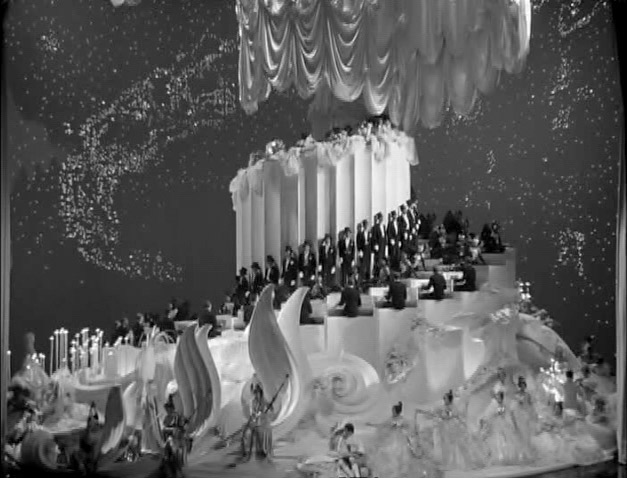
In one particularly extravagant production, Ziegfeld designed a rotating stage in which silk curtains slowly moved to reveal singing actors on higher levels designed a bit like a wedding cake. My mom and I sat amazed at the scene wondering when the rotating and climbing was going to stop and how on Earth they filmed that. It had to be the biggest stage I’ve ever seen. (Turns out, cameras back then couldn’t hold that much film, so the cameraman would zoom in on a character, change the reel, zoom back out, and continue panning.)


Although Fanny’s name was quite high in the billing, she had such a bit part in the film. But, being the comedienne she is, she owned that scene. Here is “Flo” presenting Fanny with a mink coat as his way of inviting her to the Follies. She, naturally, thinks he’s an imposter and the banter between the three of them is fantastic. (Fanny is on the right.)
 
 
FAVORITE LINE:

A very broke Ziegfeld and his new star, Billie Burke, declare their love for each other and Burke utters the most beautiful line ever (which ends up being their proposal to each other)…

FZ: There’s little I can offer you, nothing I can give you except my love.

BB: That isn’t good enough. I’d expect part of your ambition, half of your trouble, two thirds of your worries, and all of your respect.

LESSONS LEARNED:

I vow to look at my marriage through the same lens that Billie Burke did. I appreciate the way she looked at the special relationship.

If you have enough ambition, passion, and confidence, go for broke! You may actually wind up there, but then those qualities should put you right again.